Best Tender Alert Services in Canada: Paid and Free Options Compared
Compare Canadian tender alert services, from SamSearch, Bids&Tenders and MERX to CanadaBuys and provincial alerts, on coverage, matching and cost.
If you want one service that sends you matching Canadian tenders from every level of government and filters out the poor fits, SamSearch is the strongest choice. If most of your buyers post on one platform, a Bids&Tenders plan or a MERX account may be all you need. If you only chase federal work, CanadaBuys is the official source and lists no subscription fee, and a few provinces run their own alert services for free or a small annual fee.
Finding an alert service is easy. Finding one that covers your buyers and sends a short list worth reading is harder. This guide compares the main options on coverage, matching and cost.
How tender alerts work in Canada
Canadian public buying is spread across many portals. Federal departments post on CanadaBuys. Provinces run their own systems, such as BC Bid, the Ontario Tenders Portal and SEAO in Quebec. Municipalities and MASH buyers (municipalities, academic institutions, schools and hospitals) often use commercial platforms like Bids&Tenders, MERX or Biddingo.
A tender alert service watches one or more of these sources and tells you when something new matches your criteria. Most portal alerts match on commodity codes or keywords you pick. Paid services add wider coverage, better filtering and tools to track bids once you find them.
A few terms come up often:
- RFP (request for proposal): a formal request asking suppliers to propose a solution and price. You will also see RFQ (request for quotation) and RFI (request for information).
- Standing offer: an offer from a supplier to provide goods or services at set prices and terms, which the government can call up as needed. An RFSO is a request for standing offers.
- Supply arrangement: a pre-qualified list of suppliers that a buyer can invite to compete for specific requirements.
- Trade agreement thresholds: dollar values above which a buyer must advertise a tender openly under Canada's trade agreements. Manitoba, for example, says its tenders above these thresholds are advertised through MERX.
Quick comparison
| Service | Coverage | Matching | Published price |
|---|---|---|---|
| SamSearch | Canadian federal, provincial and municipal tenders, plus optional US sources | Company profile scoring, weak matches dropped before the email | Pricing on request |
| Bids&Tenders | Over 450 buyer organizations on the platform | Customized daily bid emails on paid plans | $549, $999 or $1,999 a year |
| MERX | Nation-wide tendering system used by buyers including the Government of Manitoba | Free notifications for opportunities that might interest you | Pricing on request |
| CanadaBuys | Government of Canada tender and award notices | Followed saved searches and tender notices | No subscription fee listed |
| Biddingo | Buyers that post on Biddingo, such as the City of Kingston | Account-based notifications | Pricing on request |
| Provincial services | One province each (for example BC Bid, Nova Scotia TONS) | Commodity code or category matching | Free to $100 a year |
Disclosure: Tender Reviews is published by SamSearch.
1. SamSearch

Best for: businesses that sell to several levels of government, or across provinces, and want one alert that only includes tenders they could realistically win.
What it covers: SamSearch's Canada search covers federal procurement led by Public Services and Procurement Canada and federal departments. It covers all 10 provinces through portals such as Ontario Tenders, BC Bid, SEAO, Alberta Purchasing Connection and SaskTenders, plus municipal buyers such as cities, regional municipalities and towns. It also covers school boards, colleges and universities, health authorities and hospitals, transit agencies, water utilities, Crown corporations and defence buyers, including National Defence and Defence Construction Canada. You can search Canada on its own or blend it with US opportunities in one query, which helps if you sell on both sides of the border.
How the matching works: this is where SamSearch differs most from portal alerts. You fill in a company profile once, and everything published afterwards is read and scored against it, whether or not you searched for it. Saved searches are graded before they email you: each candidate is scored against your profile and the weak ones are dropped, so the digest is a shortlist rather than everything containing your keyword. Each score cites the passage of the notice it was based on, so you can check it and disagree with it.
You can save searches by province, level of government or municipality, and filter by RFX type (RFP, RFQ, RFI or Source Sought) and by product or service. Businesses that qualify under the Procurement Strategy for Indigenous Business can isolate reserved opportunities. SamSearch reads and summarizes solicitations in English and French, including Quebec SEAO documents. Alerts can go to Slack, Microsoft Teams or email, and your pipeline syncs with CRMs such as Salesforce, HubSpot and Pipedrive.
Beyond alerts, the platform reads attachments on arrival, extracts requirements, tracks your pipeline and helps generate the bid package, so you can move from a matched tender to a response in one place.
Pricing: pricing on request. SamSearch does not publish prices. It prices annually, based on your team size and the markets you cover, with no feature tiers. Onboarding, data migration and training are included, with no setup fees or implementation charges. You get a quote after a demo built around your markets and live pursuits.
Limits: there is no public price list, so you need a demo call to compare cost. It is a full platform, so a sole trader who bids on one city's tenders a year may not need it.
2. Bids&Tenders
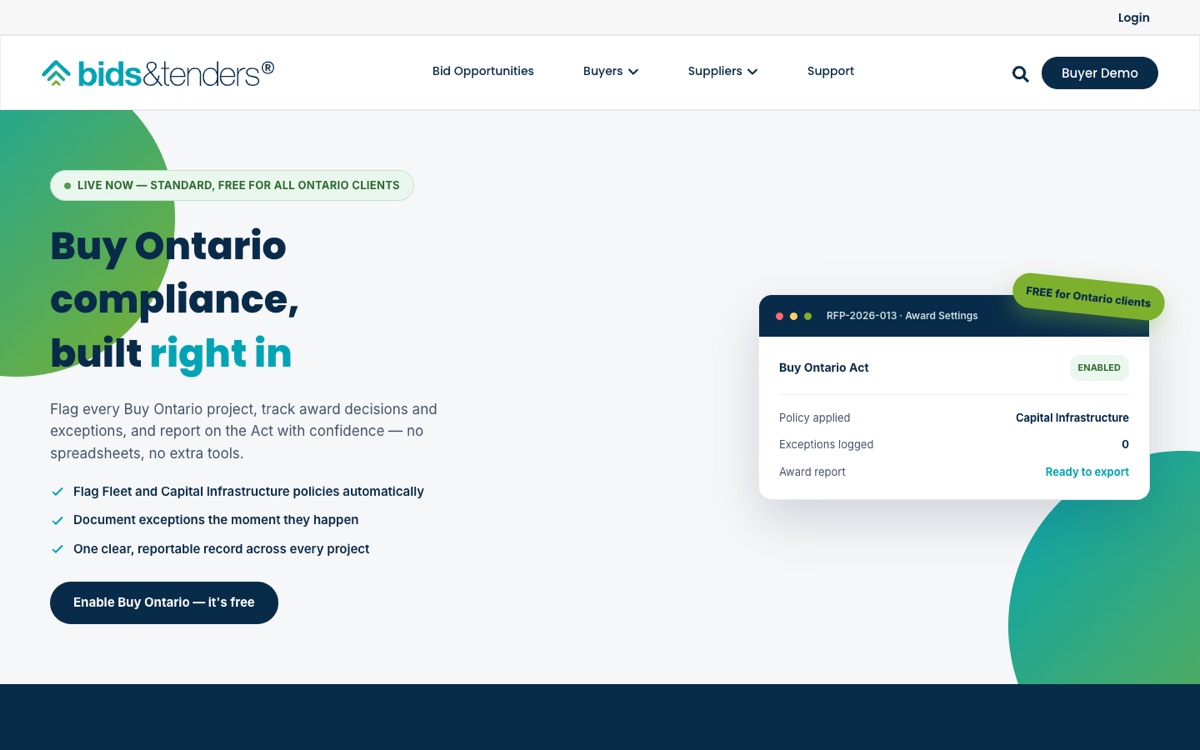
Best for: suppliers whose buyers already post on Bids&Tenders, especially municipal, utility, education and healthcare buyers.
What it covers: Bids&Tenders is an eProcurement platform for Canada and the US. It says over 450 buyer organizations use it, and it serves education, engineering and construction, government, healthcare and utility buyers. Logos on its site include Yukon and Red Deer. It has also announced a national master agreement with Kinetic GPO: effective August 1, 2026, Kinetic GPO's public sector and MASH members across Canada can access the platform.
How the matching works: you customize your profile to receive daily bid notification emails tailored to your work, from construction to consulting. You also get notifications about addenda and date changes. The plans table shows unlimited daily bid emails and a curated bid list on the paid Local, Growth and Pro plans. The free plan lets you view and search open opportunities, requirements and addenda.
Pricing: the supplier plans page lists:
- Free: view and search opportunities, requirements and addenda
- Pay-Per-Bid: covers a single bid, price not shown on the plans page
- Local: $549 a year, up to 10 agencies
- Growth: $999 a year, up to 20 agencies
- Pro: $1,999 a year, no agency cap
Paid plans are billed annually. The plans page does not name the currency, so confirm it at sign-up. Opportunities from agencies that are currently free to access stay free and do not count toward your agency limit.
Limits: alerts only cover buyers that use Bids&Tenders. If your clients post on CanadaBuys, MERX or a provincial portal, you will still miss those.
3. MERX
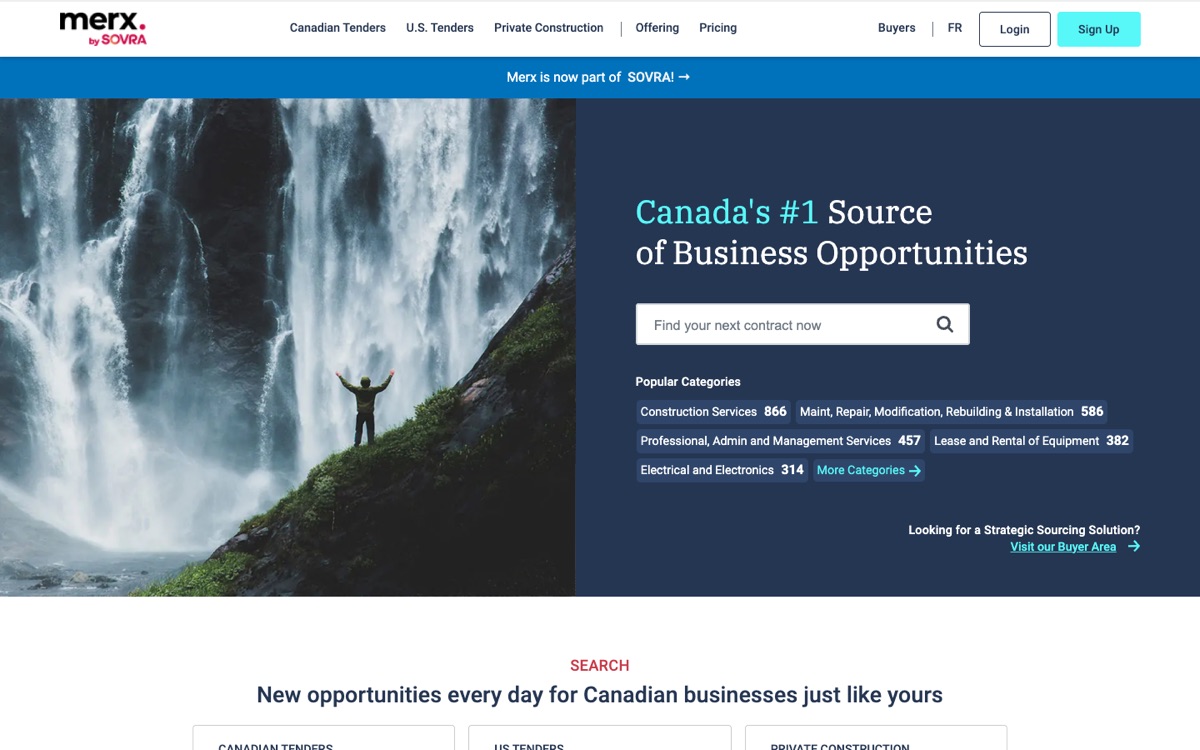
Best for: suppliers who bid with buyers that distribute tenders through MERX, such as the Government of Manitoba and Manitoba Hydro.
What it covers: the Government of Manitoba describes MERX as a nation-wide tendering system. It says government tenders that exceed trade agreement thresholds are advertised and distributed by MERX, and that Manitoba Infrastructure tenders for highways, bridges, water control infrastructure, ferries and airports can be found there. Manitoba Hydro also lists its tenders on MERX.
How the matching works: Manitoba Hydro says suppliers can register and receive free notifications when opportunities are posted that might interest their organization. MERX does not grade how well each tender fits your business, so expect to sort the results yourself.
Pricing: pricing on request. We could not read a price list on MERX's own site. Manitoba Hydro says there is no charge to view its public or restricted (if invited) tenders on MERX, and that MERX user fees only apply when ordering the documents for a tender.
Limits: document fees can add up if you bid often. MERX covers the buyers that use it, not every Canadian portal, so you will need other sources for federal or municipal buyers who post elsewhere.
4. CanadaBuys
Best for: businesses that sell mainly to the federal government and want the official source.
What it covers: the Government of Canada says CanadaBuys is the official source for its tender and award notices. You can search public sector tenders and contract history, register as a federal supplier, complete a business profile and use the electronic procurement solution to view and bid on opportunities.
How the matching works: you can follow a saved search or a specific tender notice. The Government of Canada points suppliers to a CanadaBuys guide on searching for tenders, following saved searches and notices, and using UNSPSC codes (a standard system of product and service codes). Matching is only as good as your keywords and codes, and there is no scoring of how well a tender fits your business.
Pricing: no subscription fee is listed. It is the federal government's own portal.
Limits: CanadaBuys is built around federal procurement. Provincial and municipal buyers that use their own portals will not appear in your results. For a federal-only seller, though, it is often enough on its own.
5. Biddingo
Best for: suppliers whose municipal or public sector buyers post on Biddingo.
What it covers: Biddingo is a bid platform used by Canadian public buyers. The City of Kingston, for example, sends suppliers to Biddingo to create an account to submit bids and receive notifications about new opportunities.
How the matching works: you register an account and receive notifications on new opportunities from buyers on the platform. We could not confirm the matching options from Biddingo's own site.
Pricing: pricing on request. Biddingo's site did not show a price list we could read.
Limits: coverage depends on which buyers use Biddingo. Before paying, check that the cities and agencies you target actually post there.
6. Provincial alert services
Best for: businesses focused on a single province that want a cheap, official alert.
What they cover: each province runs its own system, and some add email alerts:
- Nova Scotia TONS: once registered, the Tender Opportunities Notification Service emails you public sector opportunities that match the goods, services and construction categories you select. The province says it is available to all businesses at no cost.
- BC Bid: you choose commodity codes and get one email a day listing all matching opportunities. Notifications cost $100 a year, and e-bidding costs $150 a year. Subscriptions last one year from the date of registration and do not renew automatically.
- Ontario Tenders Portal: vendors can view and download opportunities at no cost.
- SEAO (Quebec): public bodies subject to Quebec's public contracts law must publish their public tenders on SEAO, and the same applies to municipalities and municipal bodies. Businesses can view the notices and order tender documents. Service fees are listed on SEAO's own pricing page.
How the matching works: mostly by commodity code or category. It is simple and reliable for clear categories, but it cannot judge fit, and codes that are too broad produce noisy emails.
Limits: you need a separate account for each province, and none of them cover municipal buyers that post on commercial platforms.
How to choose
Start with where your buyers post. Look at the last ten tenders you bid on or wanted to bid on, and note the portal each came from.
- All federal: CanadaBuys is often enough.
- One province: use that province's free or low-cost alert service, plus CanadaBuys if you also sell federally.
- Mostly buyers on one platform: a Bids&Tenders plan, or the MERX or Biddingo account your buyers require.
- Several levels of government or several provinces: covering this yourself means juggling several separate accounts. This is where SamSearch saves the most time, because it searches federal, provincial and municipal sources together and sends only the tenders that fit your profile.
Then test the matching. Run a week of alerts and count how many tenders you would actually bid on. A service that sends 50 notices with two good ones costs you more reading time than one that sends five good ones.
Frequently asked questions
Are there free tender alert services in Canada?
Yes. CanadaBuys lets you follow saved searches and tender notices for federal opportunities, and the Government of Canada lists no subscription fee for it. Nova Scotia's Tender Opportunities Notification Service emails matching provincial opportunities at no cost. The Ontario Tenders Portal lets vendors view and download opportunities at no cost. Free options work well if you sell to one level of government, but each covers only its own buyers.
Do I need more than one tender alert service?
Often, yes, if you rely on free portal alerts. Federal, provincial and municipal buyers post on different systems, so a single portal alert misses tenders posted elsewhere. Many suppliers end up with accounts on CanadaBuys, a provincial portal and one or two commercial platforms. A service that searches all of these together, such as SamSearch, replaces several separate alerts with one filtered digest.
How much does BC Bid charge for tender notifications?
BC Bid charges $100 a year for notifications, which let you pick commodity codes and receive one daily email listing matching opportunities. E-bidding is a separate $150 annual subscription. Subscriptions run for a year from the date of registration and do not renew automatically. BC Bid sends reminders a month before, seven days before and on the expiry date, and you can renew once you are within 30 days of expiry.
What is the difference between keyword alerts and fit scoring?
A keyword or commodity code alert sends every notice that matches the terms you chose, even when the work is too large, in the wrong region or outside your specialty. Fit scoring reads each notice and compares it to your company profile, then ranks or drops it. SamSearch grades each tender against your profile and cites the passage behind each score, so you can check its reasoning.
Is MERX free to use?
Partly. Manitoba Hydro says there is no charge to view its public or restricted (if invited) tenders on MERX, and that suppliers can receive free notifications when relevant opportunities are posted. MERX user fees apply when you order the documents for a tender. We could not read a current price list on MERX's own site, so check with MERX directly before you budget for it.
Sources
- SamSearch home page
- SamSearch pricing
- SamSearch: Find opportunities
- SamSearch: Canada contract search
- bids&tenders home page
- bids&tenders supplier plans
- bids&tenders supplier features
- bids&tenders: National master agreement with Kinetic GPO
- Manitoba Hydro: MERX
- Government of Manitoba: Government tenders
- Government of Canada: Electronic procurement
- City of Kingston: Procurement
- Nova Scotia: Sign up for tender notifications
- BC Bid supplier guide: Account management
- Ontario Tenders Portal: About
- Gouvernement du Québec: Système électronique d'appel d'offres (SEAO)
Related analysis
Best Tools for Ontario Municipal Tenders: 7 Options Ranked
Ontario municipal tenders are split across bids&tenders, Biddingo, MERX, Bonfire and city portals. Seven tools ranked, with prices and when free is enough.
MERX vs Biddingo: Which Canadian Tender Platform Fits Your Bids?
MERX vs Biddingo for Canadian suppliers: coverage, Ontario MASH buyers, exclusive postings and pricing, plus one tool that puts more tenders in one feed.